6 Eye-Opening Lessons Every Home I’ve Ever Lived In Has Taught Me

The lessons every home I’ve lived in has taught me, including one that took sixteen years to learn and might be exactly what your home needs right now.
* This post may contain affiliate links. They don't cost you a penny, but do pay a commission to this site.
Please click here for more details.
A tin of paint and a pair of curtains.
That’s what my pocket money was going on as a teenager. Not clothes, not music, not anything a normal teenager might have wanted. I’d been squirrelling it away for months so my bedroom could finally feel like mine.
That instinct – the one that says your surroundings change how you feel – has driven pretty much everything I’ve done since. It’s why I built Organise My House. And it’s why, sixteen years after moving into a house that didn’t tick our boxes on paper, we’re still here and going nowhere.
Because how you feel about your home isn’t random. It’s built, decision by decision, project by project, year by year. Home isn’t just the backdrop to your life. It’s the foundation of it. And the sooner you see that, the sooner you can start building something that feels like you, wherever you’re living right now.
So here’s every home I’ve ever lived in, and what each one taught me.
Before I Owned Anything: The Early Years
Before mortgages and building projects and all things adulting, there was my bedroom at my parents’ house, and a burning need to make it feel good.
I covered the chimney breast wall in pictures cut out of magazines, a sort of collage mural that took hours to create. I moved the furniture around constantly, just to see if it felt better a different way. I saved for that paint and those curtains. I was completely obsessed.
At the time I thought I just liked my room. Now I know it was deeper than that. I needed my space to reflect who I was, because when it did, I felt happier and calmer.
That need came with me to university, where I made a tiny, zero-budget room feel cosy and like mine within a week.
Then into my first job at IBM, sharing a house with a friend. We decorated, even though we were renting and knew we’d be moving on, because feeling good where we lived mattered that much.
It was during those years that I went through a serious period of anxiety. I’d always been prone to it, but this time it hit harder than ever before.
And here’s what I noticed. My home helped. Walking through that front door felt like an exhale, every single day. The space was calm, familiar and mine. It felt safe.
Lesson 1: Your home can be the thing that holds you together, or the thing that slowly pulls you apart. The difference is whether you’ve made it yours.
House One: Making The Most Of What You’ve Got
Our first owned home was a 1930s semi, and we loved it straight away.
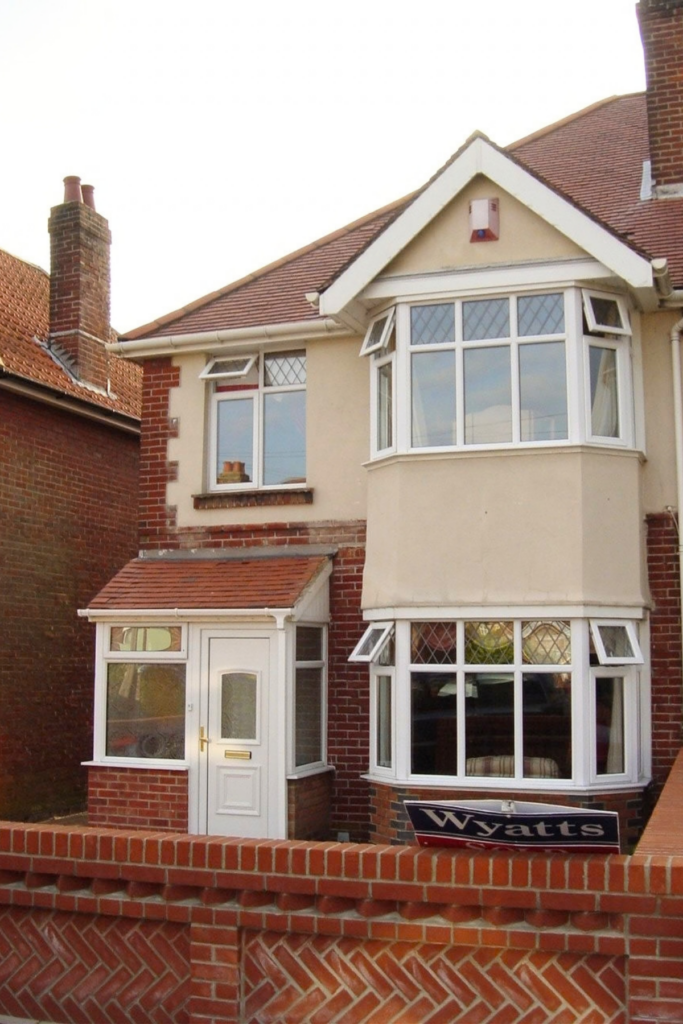
My dad always said to stretch as far as you can when you buy, to future-proof yourself. So we did, and moved in with practically nothing: a bed each from our separate rented places, a few dozen boxes and a very long wish list.
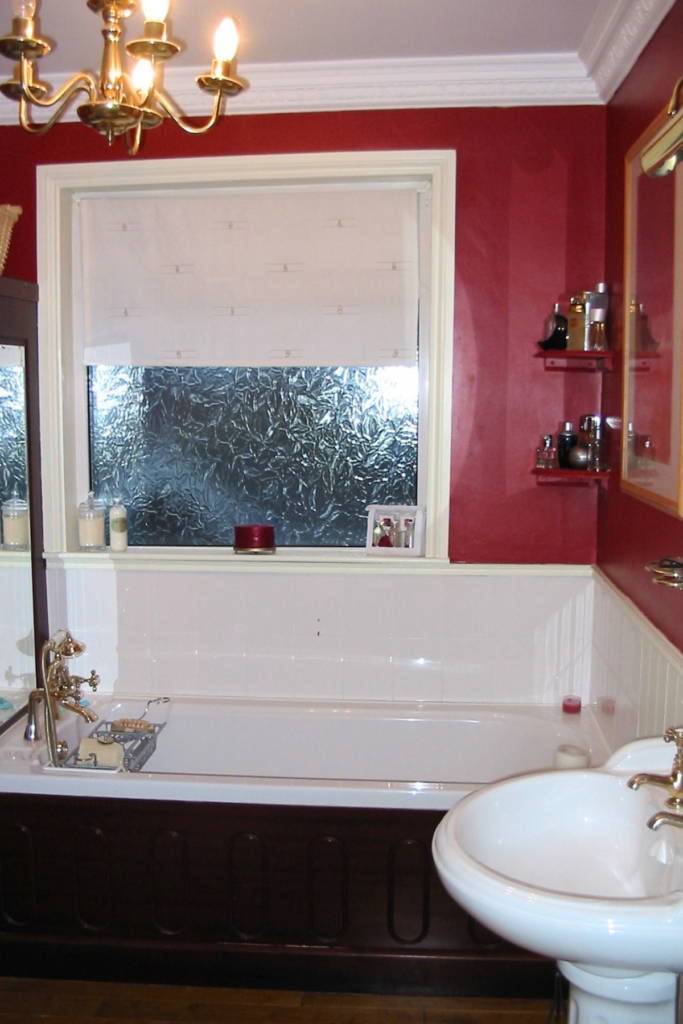
The house itself was, let’s say, a lot. Far more lavishly decorated than we’d ever have chosen. We inherited a chandelier in the bathroom. A living room fireplace nearly six feet tall, wider than the chimney breast and covered in ornate patterns. And at the end of the garden, a wooden cabin with a swimming pool inside it. Yes, really.
Before you get excited, it was a complete money pit and we never swam in it once. But I can now say I’ve owned a home with a pool, which isn’t something you hear very often in the UK!
What we didn’t have was money for big projects. So we learned to work with what we’d got.
The kitchen was tiny. Properly, laughably tiny. Less than a metre between the cabinets on each side, no more than two and a half metres long, with dark blue units and barely any light. Standing in it felt like the walls were closing in on you.
So I painted. The cabinets and the tiles became cream, and that was more or less it. Suddenly it felt a lot more bright and airy, and was achieved for almost nothing.
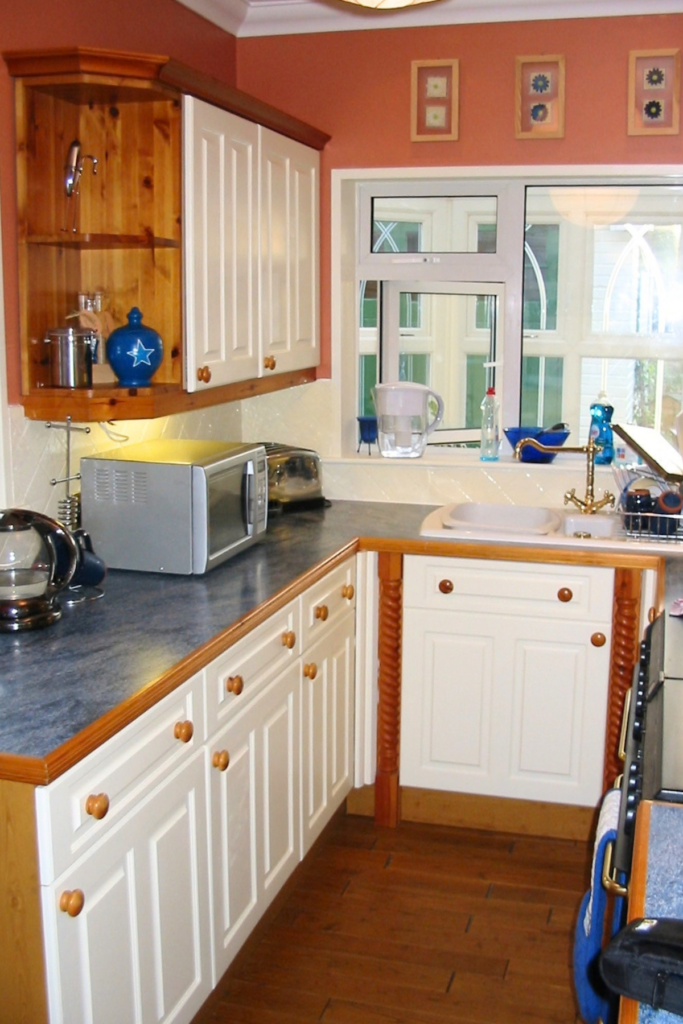
Lesson 2: You don’t need a big budget or a complicated renovation to change how your home feels. Stop fighting the space and start working with it. A tin of paint, a clear surface and a few good decisions can turn a room that feels oppressive into one that feels much more like yours.
And there was an unexpected bonus. When we sold, it went at full asking price to the first person through the door, before it had even properly hit the market. We hadn’t done this with big changes, just making the best of what we had. That felt great.

I’d also started training as an interior designer while we lived there, as I edged away from corporate life. I took up art again too, and to save money I painted abstract canvases to go with the décor. The new owners loved them so much they bought the lot. I’ll take that.
House Two: Location Over Love
Then came the big move, from the south coast up to the north west of England to be closer to family.
We loved the area. But honestly? The house wasn’t one we’d have chosen if we’d had the pick. It was 1950s, not an era we love and not a style we were drawn to. What it did have was the right location, in a lovely area. And we were starting to realise we could make the inside right for us, whatever the budget. Confidence was building!
Lesson 3: Location is the one thing you can’t change, so get that right. The house, you can work on.
So we worked on it. A complete bathroom refit, a full kitchen renovation and redecorating throughout. We had our daughter in that house. We went back and forth on extending versus moving on.
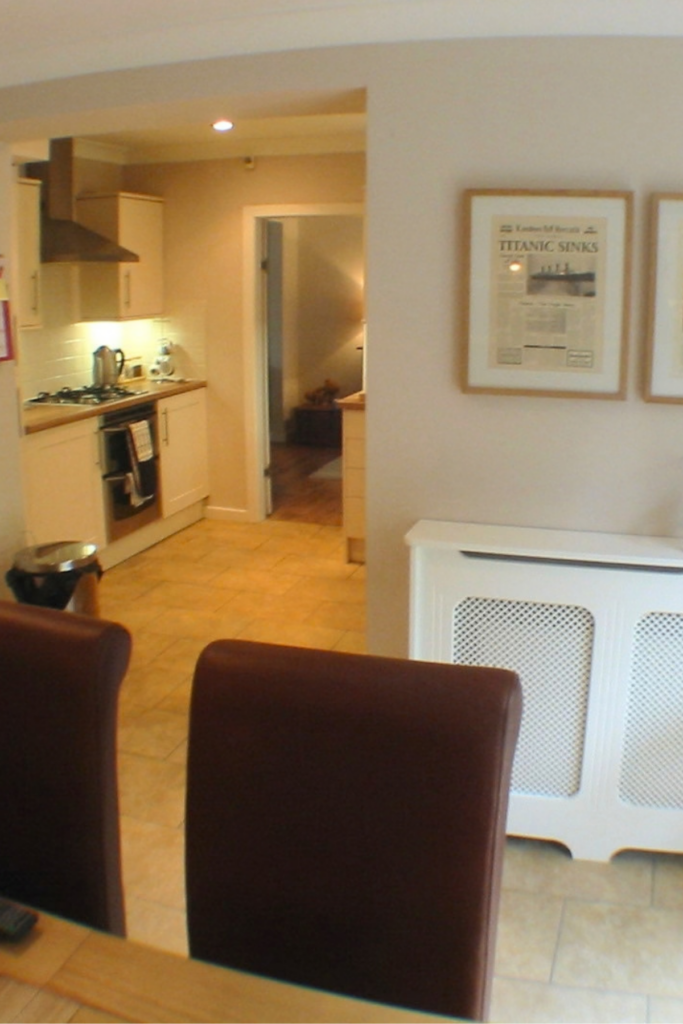
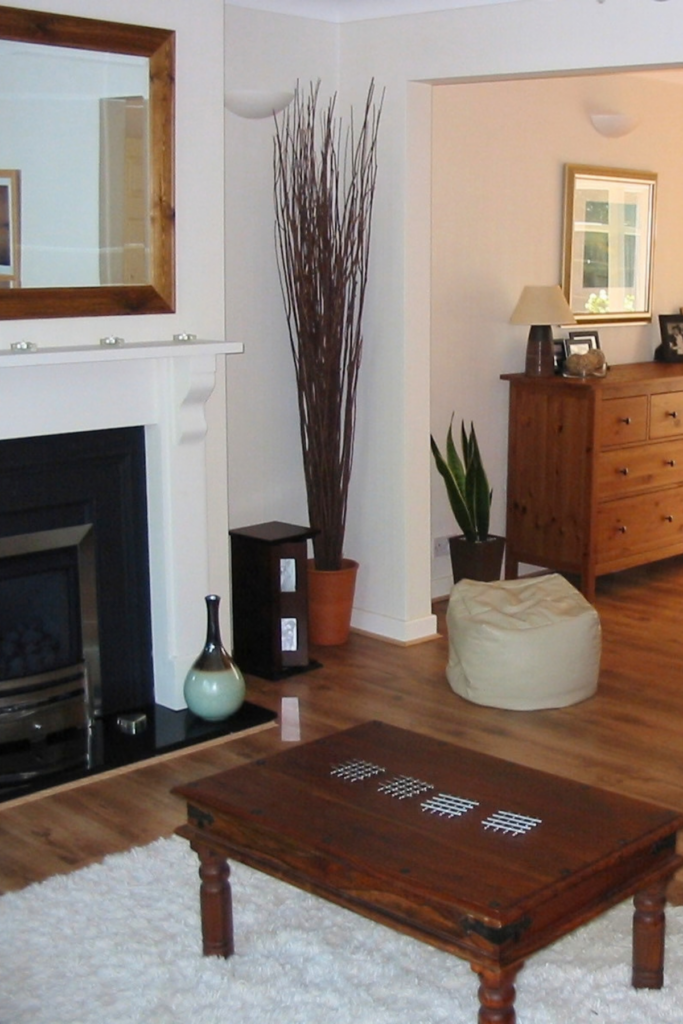
Lesson 4: A home doesn’t have to be your dream aesthetic to be right. How it lets you live matters as much as how it looks. Sometimes more.
And then, at a dinner party (these things always seem to happen at random times, don’t they?), friends mentioned a house that was about to come up for sale. We went to see it the next morning and fell in love on the spot.
House Three: The Forever Home We Didn’t Know We Were Building
We moved in thinking we’d stay five to ten years.
That was back in 2005 and we’re still there without any plans now of moving on.
On paper, it didn’t tick many boxes. We wanted four bedrooms. It had three. An ensuite? No. A utility room? Also no. A home office? You can probably guess.
But it was detached, with a garage, a lovely outlook and an easy walk into town. And it had a green, peaceful feel that caught us completely off guard.
Phase One: The Bones
We didn’t move in straight away. Our things went into storage and we moved in with my father-in-law for three months, while he (a builder, thankfully) transformed the bones of the place.
Every wall went back to brick. The separate toilet and bathroom became one proper bathroom. We closed off the glass doors between the two living rooms to make a cosier front sitting room, carved an ensuite out of part of the second bedroom and squeezed a downstairs loo in under the stairs. New lighting, and a full once-over everywhere else.
Then we ran out of money. Phase One, done.
Phase Two: Building For Someone Else
Phase Two came later. A new garage on the side of the house with a utility room behind it, an extended kitchen, a conservatory linking some of the rooms together, and a fourth bedroom above the new extension, reached by a corridor taken from part of the third bedroom.
Style-wise, we stayed sensible. Cream walls, a wooden kitchen, neutral surfaces. Nice. Inoffensive. Not entirely us.
And that was deliberate, because in the back of our minds we were always getting it ready to sell. Every choice was made with ‘most buyers’ in mind. We were designing for future-us… or worse, for future-someone-else. No wonder it never felt quite right.
It was only as the years went by, and we realised we were actually staying, that the decisions got personal. Black kitchen cabinets. Dark walls we were told we’d regret, and never once have. Shutters instead of curtains. Map wallpaper in the family room and on the landing. And no dining room, because a family room was what we’d actually use.
The irony? The cream-walls-for-everyone years got far fewer compliments than the black kitchen and dark walls ever have, even though people winced when we told them what we were planning. We played it safe for years, designing for ‘anyone’. The moment we started designing for us, people started telling us how much they loved it.
Lesson 5: Your home feels better to everyone when you’ve designed it for you, because people can sense that you feel right in it, and they mirror that back. Stop optimising for other people’s taste and trust your own.
Phase Three: Unapologetically Ours
A good few years later came the chapter I love most, where we properly took ownership and made the house ours.
- The summerhouse. The old garage was still sitting on the patio behind the new one, hanging on as storage because keeping it was cheaper than getting rid of it. It became a proper summerhouse, with bifold doors and a floral mural wallpaper that makes me feel like I’m outside even when I’m not.
- A real room instead of the conservatory. It got too hot in summer, too cold in winter, and had a leak nobody could ever seem to fix. We’d only gone for a conservatory because we couldn’t afford a brick-built room at the time, so we finally built the real thing.
- The balcony. Above that new room, off the guest bedroom. Never a must-have for selling on, always on my wish list. A proper treat.
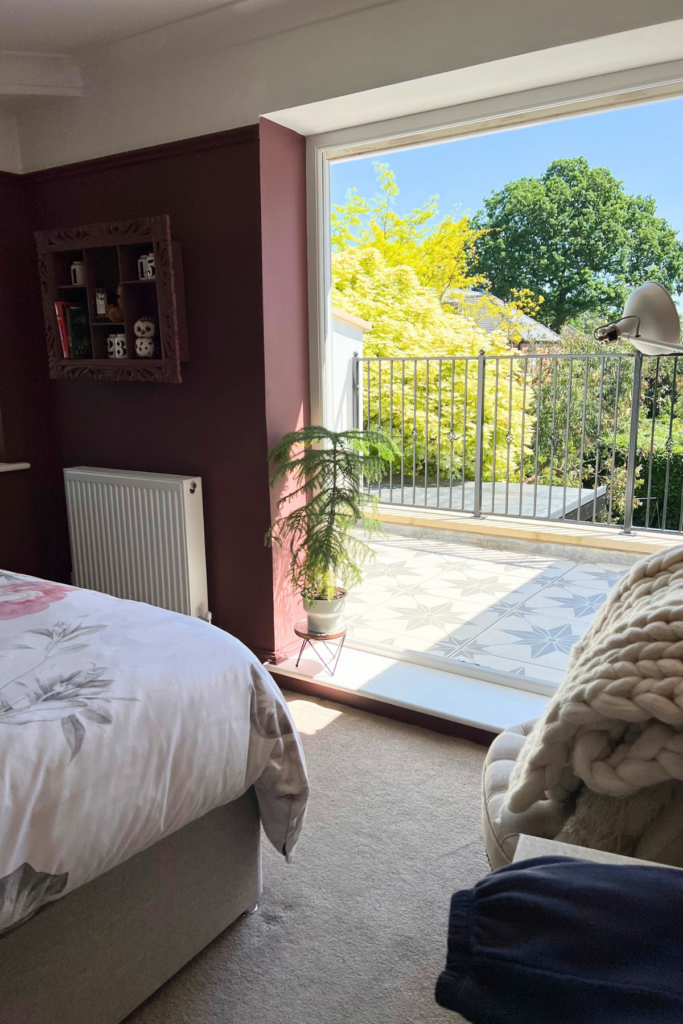
- The garage, finally lived in. We’d mainly built it because buyers round here expect one. For us, it was expensive storage. Now it’s actual living space, with a little mezzanine nook my daughter has completely claimed.
- A home office. The utility room became my office, and the utility moved into the converted garage, tucked under the mezzanine.
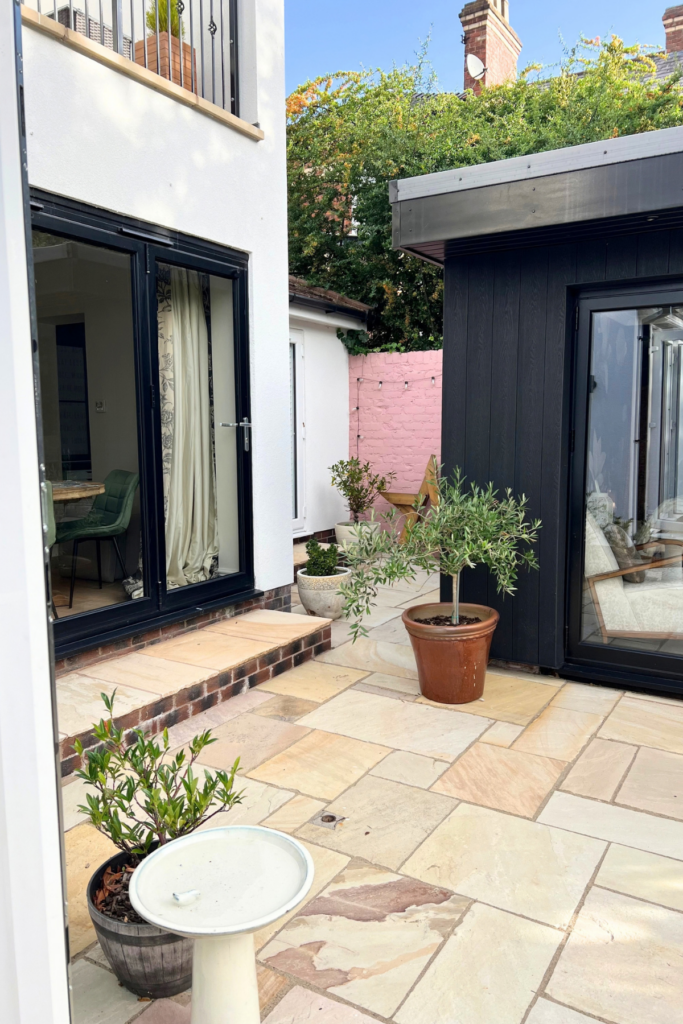
We built this house over sixteen years, one phase at a time. And looking back, I wouldn’t change that. Phases aren’t a consolation prize. They’re a strategy. Every phase was built on knowing a bit more about how we actually live here.
Lesson 6: Always set up your home for You-Now, the life you’re actually living. It’s the only certainty you’ve got, and you get to enjoy it so much more. The future will look after itself. The Feel Good Home will help get you started with this.
Related -> 3 Reasons Why Creating Your Home In Phases Is One Of The Best Decisions You’ll Ever Make
So, What’s Your Homes Journey?
All those years ago I saved my pocket money for a tin of paint and a pair of curtains because I needed my bedroom to feel like mine.
That instinct never went away. It’s driven every decision, every project and every phase of every house since.
Your story will be completely different. Different houses, different stages, different budgets, different stories.
But the instinct should be the same: for your space to feel good for you and make your life easier, every day.
That’s what I want to help you with. Not recreating my home in yours, but making yours feel like yours.
Your home is your story. Let’s make sure it’s telling the right one.
Not Sure Where Your Home’s At Right Now?
Your homes journey starts with knowing where you are today. The free Homebird Type Quiz takes two minutes and tells you exactly what kind of help your home needs right now to get it to where you feel right at home, the fastest…