5 Ways To Sort Your Books Out (& Which Is Your Best Choice)

Find out the 5 best ways to sort your books out wherever they are in your home – plus the personalised method that creates the right solution for you every time, so each book is right where it should be when you need it.
* This post may contain affiliate links. They don't cost you a penny, but do pay a commission to this site.
Please click here for more details.
You recommended it over coffee this morning. Talked about it so much your friend got her phone out to add it to her list – until you stopped her. ‘Don’t buy it. I’ll lend you mine.’
So you’ve popped back home to grab the book from your shelf.
And now you’re stood in front of the bookcase, head tilted sideways, reading spine after spine. You can picture the cover. You know it’s here somewhere.
It’s just not where you’re looking.
Top shelf. Bottom shelf. The pile by the bed. Back to the top shelf again, just in case you missed it the first time… The longer you look, the more that familiar frustration creeps in – the kind that makes you want to pull every book off and start again.
Sound familiar?
Here’s the thing. The book isn’t lost. It’s just not where YOU would look for it.
And that’s true of so much more than books. Every set-up in your home has to work for how YOU actually live in it – otherwise it’s only ever going to be a source of low-level frustration.
Yet it’s so easy to fall foul of setting things up for all the wrong reasons:
- Copying someone else. We sort things the way our mum did, or a friend does, or the way we saw online – without asking whether it suits us.
- Sorting ‘for the time being’. A quick fix to get things off the floor… that we then live with for the next ten years.
- Because it looks nice. Lovely to look at, a nightmare to actually use.
- Because that’s where the space is. The book goes on the only shelf with a gap, and that’s where it stays.
None of these are daft decisions in the moment. But they’re decisions about the stuff, not necessarily the fact that it’s YOUR stuff.
What works best – every single time – is taking a step back first. Working out what you really want and need from a space before you move a thing. Time spent up front on this pays you back for years to come, in all the minutes you’re not stood there, head tilted, searching.
Books are a perfect place to start. Look at ten people’s bookshelves and you’ll probably see ten different ways of organising them – and it shows that there isn’t one right way. But there is a right way for you.
So let’s start by looking at the options. Knowing the four main ways to sort your books – and the pros and cons of each – is the best way to work out which would actually work for you.
The 5 Ways To Sort Your Books Out
#1 – By Author
Alphabetical by author surname – the library way. If you tend to think along the lines of ‘I fancy something by <author name>’ rather than ‘I fancy something gripping’, this one’s probably for you.
The pros
- Finding a specific book is quick – straight to the right letter, done.
- An author’s books all sit together, so you can see your whole Hilary Mantel collection in one row.
- There’s one clear rule, so you never have to decide where a new book goes.
The cons
- It’s no help at all when you’re browsing by mood – you need to already know what you’re after… and that’s not always how reading works, is it?
- It needs a bit of discipline. Every new book has to go in its proper place, not just onto whichever shelf has a gap. It adds a little friction that may not suit you over time.
- It’s less useful for non-fiction, where you’re more likely to remember the topic than the writer.
Best for: bigger, fiction-heavy collections where you find your way by writer rather than by mood.
#2 – By Title
Alphabetical by the book’s title. Less common than by author – but it has its place.
The pros
- It’s brilliant for practical books. ‘Where’s the sourdough book?’ is a title question, not an author one.
- It suits you if you remember what a book’s called more easily than who wrote it.
The cons
- Titles are trickier to remember exactly than names. Was it The something? A something? (If you go this way, decide how you’ll handle those little words and stick to it – it’s the inconsistencies that make a title system fall apart.)
- Completely unrelated books end up side by side, which can feel a bit random.
- Series get split up if the titles don’t fall in order – properly irritating if you like reading in sequence.
Best for: reference and non-fiction shelves with memorable titles.
#3 – By Genre
Splitting your shelves into broad zones – crime, cookery, travel, non-fiction.
The pros
- You can browse by mood. When you go to your shelves you often know what you fancy before you know which book.
- You always know which area to head for.
- It’s flexible – each zone can be sorted in whatever way works for that type of book.
The cons
- Some books won’t have just one genre. The classic novel that’s really a thriller. The memoir that’s also full of recipes. Each one needs a decision, and some are genuinely hard, otherwise you won’t find them when you want them.
- Get too specific (‘Scandinavian crime’, ‘historical crime’) and it turns into a lot of upkeep. Just like with filing, aim to keep categories broad – just ‘crime’ will do.
Best for: readers who browse by mood, with a good spread across different kinds of book.
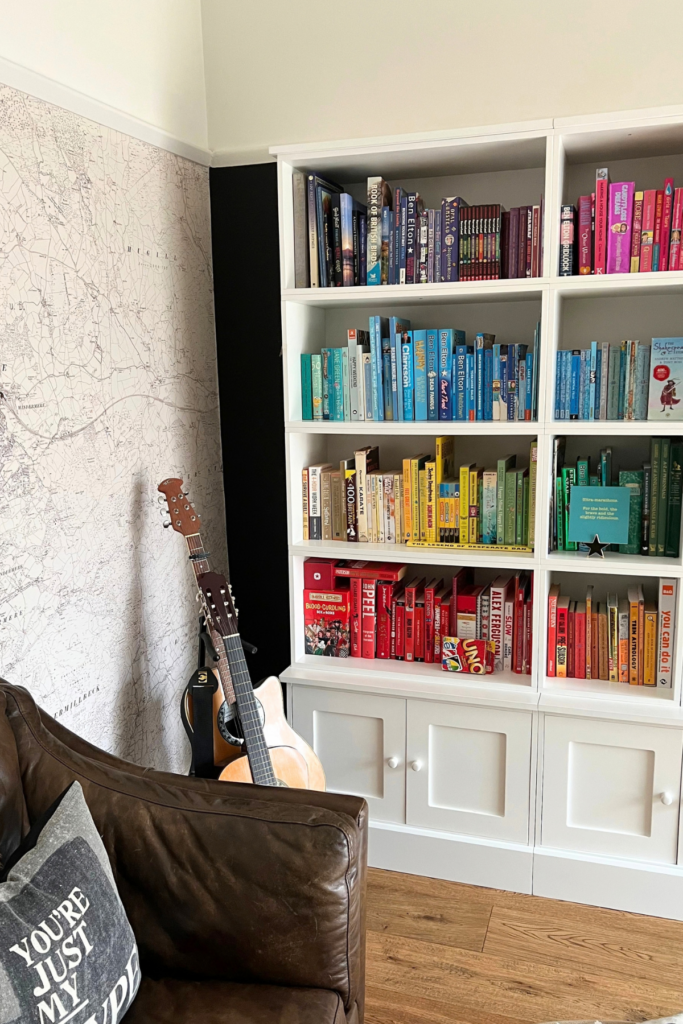
#4 – By Colour
Arranging your books by spine colour – the famous rainbow shelf.
The pros
- It’s gorgeous. Let’s be honest – a good rainbow shelf is one of the more satisfying things to look at (I love it!).
- It makes a room feel calm and pulled together – less busy in a lot of ways.
- It’s genuinely fun to set up.
The cons
- It’s not how anyone remembers a book. You think of the title, the author, the story – not the shade of the spine.
- Finding one specific book means scanning every colour it could possibly be… or remembering that your particular copy happens to be red.
- On a big collection, it turns into more of a display than a way of finding anything.
Best for: display shelves, smaller collections – or as a second layer on top of another system (more on that in a minute).
#5 – By Size
Arranging your books by how tall or short they are – so they feel more aligned on the shelf. The usual way is to have taller books on lower shelves, working the way up to shorter ones on the higher.
The pros
- It looks really neat and tidy – easy on the eye
- There’s an element of safety in it, because the taller books are usually heavier than the shorter ones – and so having these at the bottom of a bookcase makes them less likely to fall and hurt someone, and also weigh down the shelves in the right way so they’re not top heavy.
The cons
- As with sorting by colour – the size of a book is rarely how anyone remembers it. This means you’re likely to be searching through every shelf every time you want to read something specific.
- Again, as with sorting by colour – on a big collection, it turns into more of a display than a way of finding anything.
Best for: (same as sorting by colour) – display shelves, smaller collections – or as a second layer on top of another system.
How I Sort My Books (& Why)
I wanted the aesthetic of colour coded shelves, and so I started off by sorting mine out like that (see the colour coded section photo above) – but after a while it was very problematic.
So I updated it – and this meant not sticking to just one way from above.
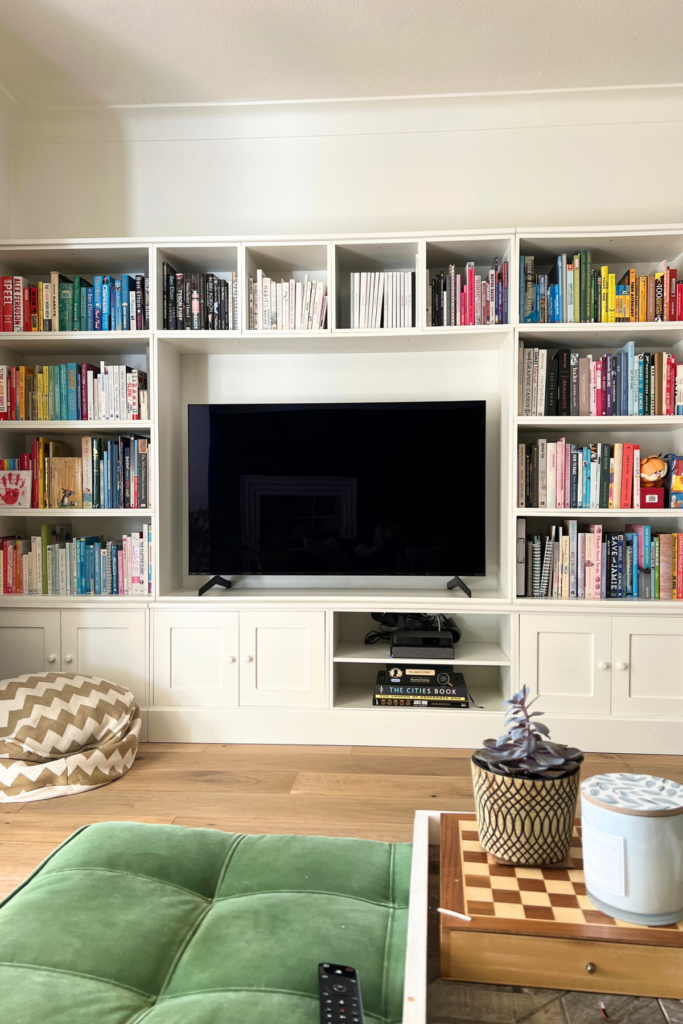
My main bookcase is a big unit in our family room that has shelves around our TV. It has sections – which I realised could be divided really nicely into enough space for each genre we have:
- Recipes
- Childrens
- Reference
- Work related
- Fiction
- Hobbies
- Photo books
This means that when I go looking for something, I head straight to the right spot. Then I go a couple of steps further and deal with the aesthetics (as this is important to me, and there are few enough books in each section to make this fine to sort by).
Within each genre, I sort by colour and then size. I take each section from red, through the colours of the rainbow – to end up with the neutral colours at the end by the TV.
When all sections are done in this way – the overall look is like a rainbow – while still being sorted out enough to be able to find what I need, when I need it.
A couple of things to note though:
- Kids books are near the bottom – as these are used by my little niece and nephew now – so they can grab them when they visit. This stops them having to ask for them all the time!
- If I had more books, I’d do it differently. A bigger fiction section, for instance, would probably get grouped by author – because scanning a whole wall of spines by colour to find one novel? No thanks.
And that’s my set up. Some of it is trial and error. We set it up one way, lived with it for a bit, noticed where we kept getting caught out… and tweaked it. It’s now set up for us (our YOU-NOW Home in practise!), and we love it.
The Method That Will Work Best For You
Which brings me neatly to the method most of us finds the best. It’s not really ever going to be neatly one of the 5 ways I listed above: it’s much more likely to be a mix of two or more of them in a way that makes sense for how you actually use them and want to live with them.
For example: Fiction by author. Non-fiction by genre. Cookbooks in the kitchen rather than the study – colour coded for a pretty look. A shelf for all the books you haven’t read yet – in genre order. Each section gets its own rule, chosen on purpose.
The pros
- Each section matches how you actually look for that type of book.
- Books can live where they’re used, not just where the bookcase is.
- The result is more personal – and a lot more useful.
The cons
- It takes more thought up front to set up.
- It can drift over time unless each section’s rule is easy to remember.
- It may make perfect sense to you and none at all to anyone else in the house unless you get them all involved.
Best for: most of us, honestly – especially with a varied collection or books in several rooms.

So, Before You Pull Everything Off The Shelves…
That bookshelf you’ve sorted (more than once) and still can’t find anything on?
It almost always comes down to a system that looked right from the outside but wasn’t built around how you look for books.
Instead, start by thinking about the last three times you went looking for something specific.
How did you look? By author? By what it was about? By where you used it last?
That instinct is your system. Work with it, not against it.
Because next time you promise to lend a friend that book you can’t stop talking about, you’ll walk straight to it – and be back out of the door in seconds, not twenty frustrating minutes later.
Perfect!