
12 Important Things To Record About Your Health (& The Best Ways To Track Them)

A practical guide to the health information worth recording for yourself, a child, a parent, or anyone else you help care for – plus a comparison of the best ways to track it, so the right details are ready whenever they’re needed.
* This post may contain affiliate links. They don't cost you a penny, but do pay a commission to this site.
Please click here for more details.
This is a paid partnership with Biojrnl
I’m sat with my parents in a small consultation room.
The consultant is asking when Dad started the new blood pressure tablets – what the dose was before, whether anything changed after his last appointment.
Mum has some notes that she wrote down last night ready – hoping that nothing’s missing. I’m scrolling through my phone for a text I vaguely remember sending with the details in it. Somewhere, we know, there’s a note with the right info on it. Written down at the time, but lost at some point in the process.
We hadn’t known, right at the start, that things would get this complicated.
Nobody sits down after an appointment thinking that it will be the beginning of something that’ll need to be tracked properly.
We didn’t.
And so, somewhere along the way, it overtook us. More appointments. More changes. More to remember. All before we’d noticed we needed something better than random notes, emails, and texts.
It was all noted down when it happened, we just couldn’t recall it all when it mattered.
Hindsight’s a wonderful thing. We’d have given quite a lot a few months in to have been organised from the very start.
What we’d needed was one place for all of it. Written down as it happened, not pieced together after the fact.
This isn’t a problem that’s specific to my parents. It’s applicable to everyone. Having the right information to hand is a true game-changer to stay on top of everything and have it to hand when needed.
But what should you track? How do you know what will be useful and what’s a waste of time?
That’s what I want to look at today.
12 Things Worth Recording
The thing is, you don’t know what’s important until after the fact. So you have to think of tracking things from the point of view that you’re creating a snapshot of your health, where the info exists for the moment you need it.
You may have existing notes, you may not. Things change though – and you don’t know what information you’ll need and when you’ll need it – and so whether you think you need to track or not – it’s worth it. Otherwise you’ll be in that appointment trying to work it out in real time – only remembering something important after you leave.
So let’s take a look at the things I’d recommend recording in one place, from today.
1. Medications
What’s being taken, at what dose, and when – plus, whether it was actually taken that day if that matters for your care.
Also track every time a dose changes, a medicine is swapped, or something new gets added, note the date and who made the change.
Medication details often come up in appointments and can be difficult to recall accurately, especially if more than one clinician is involved in your care.
2. Symptoms
Anything specific to you that’s changed, or needs to be tracked if it’s an existing symptom.
What’s happening, when it started, and how it feels, along with anything that seems to trigger or ease it.
One symptom on its own is a single data point, but a series of observations can help you see what tends to happen much more clearly.
3. Appointments – Past And Upcoming
For each meeting you’ve had, you want to record who it was with, what was said, what was decided, and what happens next.
Alongside this, you want to keep a running list of what’s still to come, so nothing gets lost between different appointments or departments.
4. Test Results
Blood tests, scans, and anything else that comes back with a number or a result attached.
Even if you don’t follow every figure, keeping the result means you can compare it with the next one and ask questions if something changes.
5. Vaccines
When was the last time you had the flu jab, or anything else you need regularly?
Also include any one-off immunisations. This can be especially useful for children’s records, or if travelling anywhere that needs them.
6. Vital Signs
Blood pressure, temperature, pulse, and oxygen levels – if relevant for you.
Regular readings can give a healthcare professional context – and allows you to seek medical advice if a reading or symptom worries you.
7. Sleep
How much, how well, and any disruptions.
Sleep can affect many parts of daily life, and illness or treatments can affect it. A short note of how you sleep can make any changes much easier to identify later.
8. Nutrition & Diet
What’s actually being eaten, appetite changes, any new intolerances or aversions.
Changes in appetite, eating, or tolerance to foods can be useful to note, particularly if they continue or occur alongside other symptoms.
9. Weight
An occasional note of weight, up or down.
Consultants ask for this more often than you’d expect as a matter of course, plus any unexplained change in either direction are worth speaking to a healthcare professional about if you’re at all concerned.
10. Bladder & Bowel Habits
Not the most glamorous entry on this list, but changes can be useful to describe to your healthcare provider along with dates that can be difficult to reconstruct later from memory.
This really is worth recording honestly, even if it feels like an odd thing to write down!
11. Questions & Follow-Ups
Whatever crosses your mind between appointments, including the thing you meant to ask last time and forgot, the referral nobody’s followed up yet.
Write it down the moment it occurs to you as then you’re not relying on your memory at all.
12. Key Contacts & Essentials
Consultants’ names and departments, ward or clinic numbers, allergies, next of kin details. The kind of thing you assume you’ll remember until you’re stood at a reception desk with your mind completely blank.
When Should You Track All This?
Reading back through that list, it might feel like a lot. It can sound like yet another job when you’ve already got lots going on. That reaction is entirely fair.
But here’s the thing: most entries don’t have to be long. Recording only what’s relevant to you can take just a couple of minutes a day.
Done over the morning coffee, or after an appointment, or whenever you prefer – the best routine is one that you can keep.
Those few minutes spent clearly recording it can save lots of time when you need to find it again – which is worth it for sure!
Why Bother Tracking Any Of This At All
Doctors and consultants only see the part of your health that relates to each appointment. But you’re the one who sees everything that happens every day.
This is why it helps to have clear notes and questions written down.
After all – you might start to notice more easily that someone is more breathless on certain days, that sleep has changed after a new medicine, or that sickness followed a particular food.
Each observation on its own may not tell you much, but dated notes can help you explain what happened, and when.
So, How Should You Actually Track It All?
Once you know what’s worth recording, the next question is where it all lives.
There’s no single right answer, it really depends on how you like to do things, who needs access, and which format you’ll actually keep using.
Here’s how the main options stack up.
Printable(s)
You can find printables for tracking these things online. I have a few trackers in the Printables Library and there’s a place in my Home File for personal info, for instance.
They’re good because you can pick what you need, print it off, and get started. Add them to the bathroom door, or put in your planner, wherever works best for you.
The catch is that you’re limited to whatever’s on that particular sheet. Want to track something it doesn’t cover? You’re improvising in the margins. And it’s paper – if it’s lost or damaged, or left behind, then that’s that for your information.
A Notebook Or Diary
This is about as flexible as it gets. You can record anything, in any order, at any length, with no missing categories.
The downside is the amount you have to write down each day – because nothing is filled in for you.
And like printables, it’s also a single copy: if someone else needs to see it, it has to physically change hands.
A Notes App On Your Phone
For me, this is a step up from the written notebook in some ways.
You get the same ability to write things down as you want to, but your phone is usually in your pocket, which makes it brilliant for capturing something the second it happens – a symptom, a question, or a passing thought.
The issue is that a long note can become difficult to organise and review over time.
A Shared Document
Worth considering if more than one of you is involved in the caring – such as siblings sharing a parent’s hospital visits, or parents sharing info about a child.
A shared document means everyone’s working from the same information, it can be updated in real time and used on a phone or a computer.
The downside is that it only works if everyone uses it, and without some structure, it can become another long scroll.
A Spreadsheet
I like spreadsheets for most things, so had to add one here as an option.
You can set up your own columns, track exactly what matters to your situation, and actually see trends over time rather than hunting for them.
It can be shareable, printable, and free.
The catch is the setup. Someone has to build and maintain it, and it only earns its keep if the person doing the day-to-day recording is comfortable opening it regularly.
A spreadsheet can also be awkward to use on a phone, particularly during an appointment.
A Dedicated App
Most of us already carry a phone and so a well-designed, user-friendly app is a really good option to consider.
I was approached a while ago by Adam from Biojrnl.com to test theirs out, and I have to say I’m loving it so far!
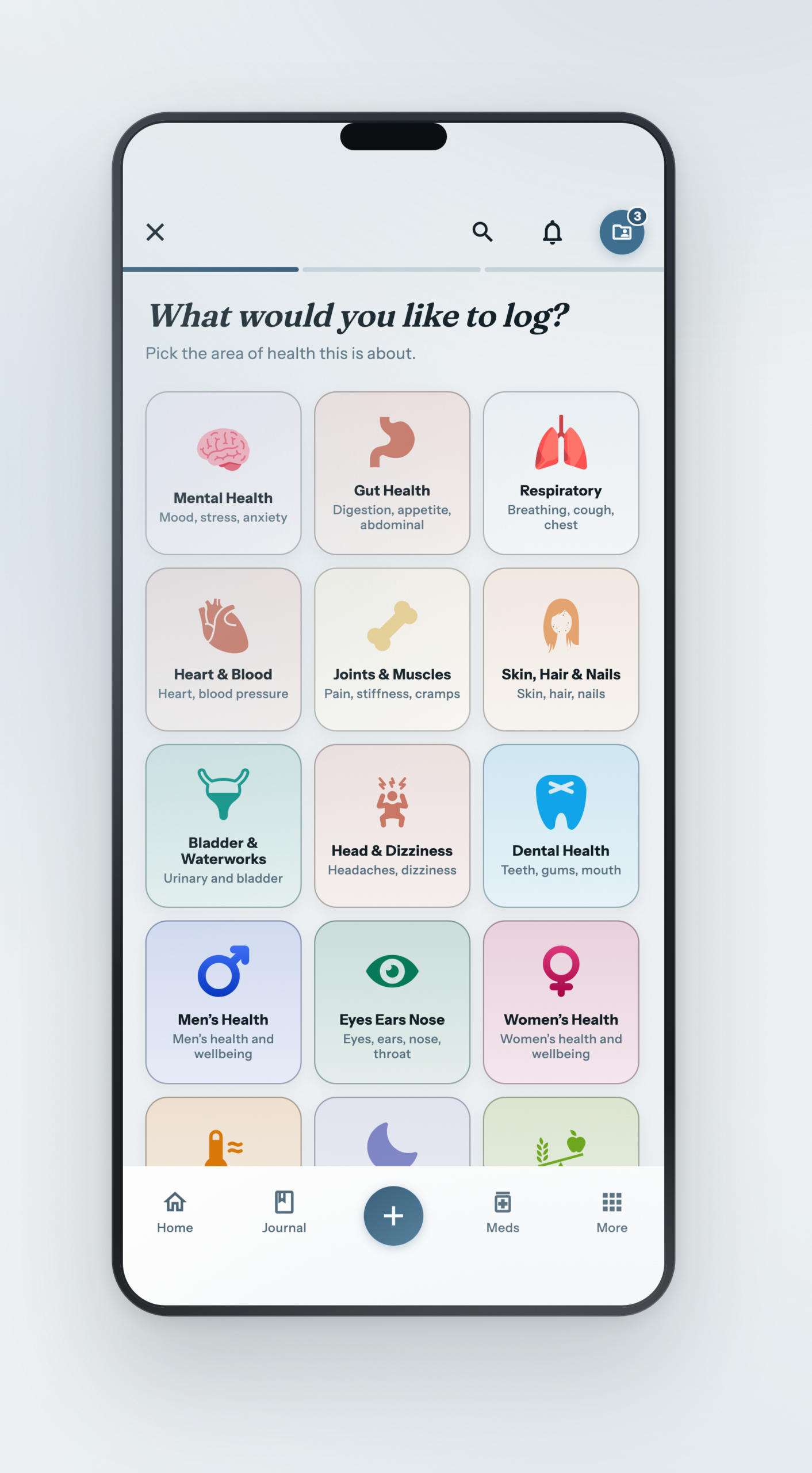
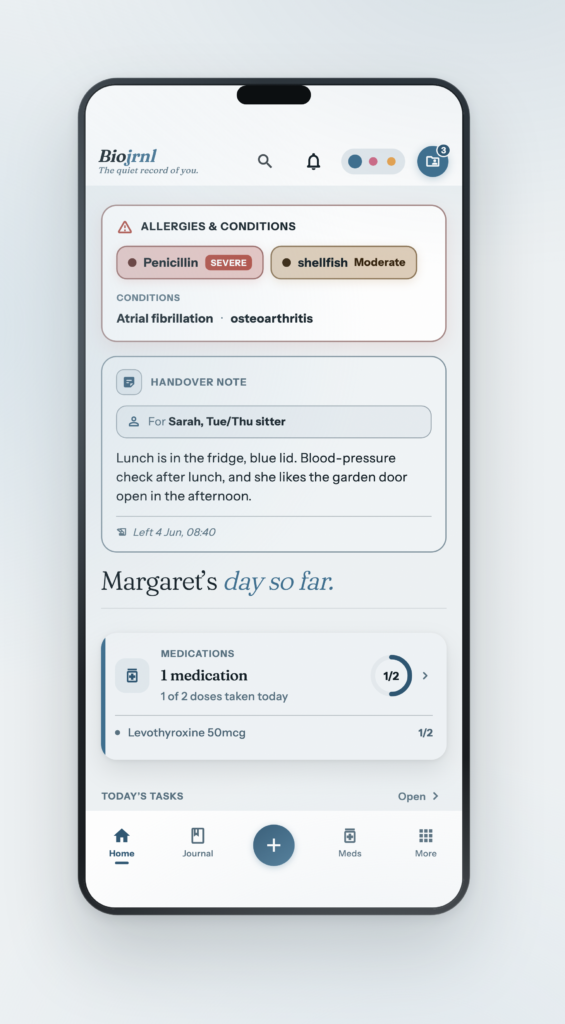
Biojrnl is a private personal health journal, which lets you record things in your own words alongside medication, appointments, vaccinations, test results, and documents.
The Family and Care plan options allow you to create separate profiles for people you care for, and guest views let you choose what another person can see and for how long.
IMPORTANT NOTE: The app records what information you enter, and doesn’t diagnose or recommend treatment.
The feature I find most useful is being able to add regular medicines once, and then record doses without re-typing it all each day.
You can also create printable summaries, including a Health Passport and GP Prep Report, from the information you’ve entered. These give you something organised to take with you to any appointments you have,
This makes it a real game changer!
It’s the closest thing I’ve found to setting it up once, then just keeping it ticking over, and honestly I wish my Dad had had this when we started his health rollercoaster this year.
Here’s an idea of what you get on the inside –
If you like the look of this app, you can get more info HERE – and I’d highly recommend giving it a go.

So there you have it: what to record, and ideas for how to keep it together.
Which leads me back to that consultation room….
My parents and I did eventually piece things together enough to inform each consultant – but I remember thinking, sat in each room, that we shouldn’t have had to reconstruct the information each time.
If we’d known, right at the start, how complicated things would get, we’d have put something in place from day one.
We didn’t know though, and that’s really the point – you rarely do, until you’re already behind.
So if you do one thing today – start by thinking about what information you’re most likely to need to track, choose where you’ll keep it and when you’ll update it, and get started.
One place for it all. Starting now. Your future self, sat in a consultation room trying to recall everything, will likely be very glad you did.
I want to thank Biojrnl for sponsoring this article. Biojrnl is a personal journal for your own records. It does not provide medical advice, diagnosis or treatment. If you are worried about a symptom, medicine or reading, speak to a qualified healthcare professional.


