When Decluttering Feels Like Grief: 5 Tips For Letting Go

Decluttering isn’t always about stuff – it’s often about stories within those items. You start clearing a drawer, and suddenly you’re face to face with memories you didn’t expect. If you’ve ever felt caught off guard by emotion while tidying, you’re not alone. Let’s look at how grief shows up in decluttering – and how to navigate it a little more easily.
* This post may contain affiliate links. They don't cost you a penny, but do pay a commission to this site.
Please click here for more details.
Decluttering can catch us off guard. One moment you’re clearing a drawer, and the next you’re holding something in your hands – a jumper, a letter, a photo – and you feel it.
That ache. That tightness in the chest. That sudden, overwhelming sense of loss.
You weren’t expecting this. You thought you were just sorting through clutter. But now, here you are, deep in memories and tears and a wave of something much bigger than “stuff.”
This is grief.
And it’s more common in decluttering than most people realise.
Grief Isn’t Just About Loss – It’s About Change
Grief shows up in all sorts of forms. It’s not just about death. It can be the end of a chapter, a change in identity, a shift in what used to be.
- That baby grow reminds you of a time when your arms were always full – and now the silence feels louder.
- That coat belonged to someone who isn’t here anymore, and touching it brings them back so vividly you forget to breathe.
- That box of old notebooks makes you think of who you once wanted to be – and who you never quite became.
Decluttering asks us to make decisions. But sometimes, those decisions stir up emotional truths we haven’t had to face in a while.
That’s not failure. That’s humanity.
Why This Matters
When people hit emotional items during decluttering, they often think something’s gone wrong.
- “I’m too sentimental.”
- “I should be over this by now.”
- “I’m making a fuss over nothing.”
But grief doesn’t follow rules. It isn’t linear. And it certainly doesn’t care whether today was meant to be your ‘productive’ day.
If grief shows up while you’re decluttering, it’s not because you’re weak or unprepared.
It’s because something in that object holds weight – and you’re brave enough to face it.
So instead of pushing it down or brushing it off, let’s look at how to work through it.
1 – Acknowledge What You’re Feeling
The first step is simple but powerful: name it.
Say to yourself:
“This isn’t about clutter. This is about memory. About love. About change.”
Acknowledging the emotion gives it space to move. It stops you from spiralling into shame or self-judgement.
You don’t need to explain it away. You don’t need to rationalise. Just notice it, and be present with it for a moment.
2 – Use Objects As A Way In – Not A Weight
The item you’re holding? It’s not the memory itself.
It’s a doorway. A reminder. A symbol.
But the memory – the relationship, the era, the version of you – that lives in your heart, not in the drawer.
Ask yourself:
- What is this object reminding me of?
- What part of me feels connected to it?
- What am I afraid will disappear if I let it go?
You’re not trying to distance yourself from the past. You’re just choosing to carry it differently.
3 – Honour Before You Release
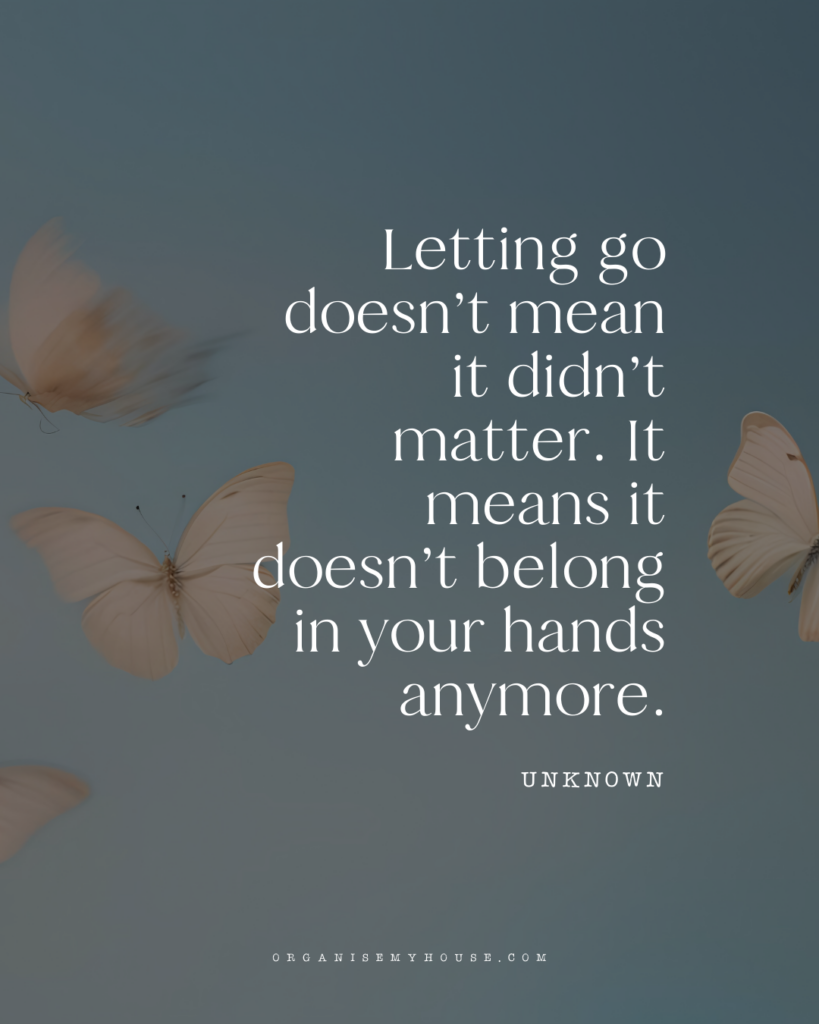
Letting go doesn’t have to be clinical or abrupt. It can be respectful. Even sacred.
Some ideas:
- Say thank you – out loud or silently. Acknowledge the role this item played in your life.
- Tell the story – share it with someone who’ll listen, or write it down.
- Create a keepsake – take a photo, start a memory box with limits (one shoebox, one shelf), or repurpose a small part of the item into something else.
The goal is not to forget. The goal is to release without regret.
4 – Make The Decision Now – With Full Presence
This is important: once you’ve felt what needs to be felt, make the decision.
Avoiding the choice only drags the weight with you. That box won’t feel lighter six months from now – it’ll just carry more dust and emotional baggage.
When you hold an item with presence and honesty, the decision becomes clearer. It may still be tender, but it’s not muddy.
Give yourself permission to choose:
- “I will keep this because it genuinely comforts me and adds to my life.”
- “I will let this go because I’ve honoured what it meant, and I don’t need to carry it anymore.”
Both are valid. Both are courageous.
5 – Understand That Grief Is Part Of The Process
We often think of decluttering as something clean and tidy – “before and after” pictures, neat stacks of donations, instant lightness.
But for many of us, it’s not like that at all. It’s stop-start. It’s emotional. It’s layered with history and longing and identity.
Grief is not a detour in your decluttering journey. It is the journey.
It means you’re engaging with your life, not just your things. It means you’re growing.
And with every decision – even the hard ones – you’re shaping a home that reflects who you are now, and where you’re going next.
You’re Allowed To Feel Like This
You don’t have to be ruthless to be effective, you don’t have to shut down your feelings to move forward – and you don’t have to be unemotional to be strong.

Decluttering with grief is hard. But it’s also deeply meaningful. And you are absolutely strong enough to do it with honesty, integrity, and compassion.
So if you’re sitting on the floor, surrounded by memory-heavy objects, with tears in your eyes – take a deep breath.
Feel what you need to feel, decide what needs to go, and then let go – not with coldness, but with gratitude and clarity.
Because the space you’re creating isn’t just in your cupboard. It’s in your heart. And it’s making room for the life you’re still living